
Solution
Virtuele machines van de juiste grootte Azure voordat de piek van gisteren morgen de rekening wordt.
Azure VMs worden vaak op maat gelaten voor migratie, lancering of in het ergste geval van vraag. EtherInsights helpt teams om oversized en inactieve berekeningen te signaleren, veilige wijzigingen te valideren en besparingsbewijs te produceren waarop eigenaren kunnen handelen.
Vanaf £0.79 per actieve gebruiker/maand · gratis proefperiode van 14 dagen
Creditcard vereist om te starten. Verbind je tenant in minuten.
10-20%
Terugkerende Azure besparingen die vaak beschikbaar zijn door het juiste maatstaf en terugvorderen
Eigenaar-geleid
Elke kandidaat voor het aanpassen van de grootte heeft een technische eigenaar en een beslissingsroute nodig
Eerst bewijs
Gebruiks-, kosten- en afhankelijkheidscontext vóór verandering

Bijgewerkt op 14 augustus 2026
The problem
Azure VMs oversized omdat niemand de productie wil onderbreken voor een klein oogend besparing.
Azure virtual machines often stay sized for yesterday's peak, an old migration assumption, or a cautious launch window. Finance sees the monthly charge, but IT needs workload evidence, ownership, and a safe action path before resizing compute.
Op maat voor een oude piek
De rekenkracht werd verhoogd voor een migratie, lancering, testcyclus of seizoenspiek, en daarna nooit beoordeeld ten opzichte van het huidige gebruik.
Het bewijs is verdeeld
Kosten, CPU, geheugen, uptime, eigenaar en workloadcontext staan in aparte weergaven, dus het aanpassen van de grootte duurt langer dan zou moeten.
Risico vertraagt de actie
Teams aarzelen om de grootte te herschalen, te sluiten of VMs in te plannen wanneer het afhankelijkheidsbeeld onduidelijk is of niemand de uiteindelijke beslissing heeft.
What changes
Verander computerverspilling in gecontroleerde acties.
Kandidaten van de juiste grootte prioriteiten
Oppervlakte VMs waar kosten en benutting suggereren dat de huidige SKU niet langer past bij de werklast.
Door de eigenaar gesteunde recensie
Koppel elke kandidaat aan de juiste technische of service-eigenaar voordat de wijziging een ticket of governance-actie wordt.
Besparingsbewijs
Houd voor- en na-kosten, beslissingsnotities en vervolgbewijs klaar voor beoordeling van financiën, IT-leiderschap en MSP.
Start here
Vind de VMs die nog steeds kosten rekenen voor een oude aanname.
Bekijk dit werkend in uw eigen tenant.
Gidsen en analyses over dit onderwerp
De VM maatmeting
Ga van hoge rekeningen naar veilige computerbeslissingen.
EtherInsights verbindt kosten, benutting, eigendom en beoordelingsbewijs zodat VM veranderingen niet worden gezien als blinde kostenbesparingen. Beslissingen worden aangepast aan grootte, plannen, reserveren of behouden met context.
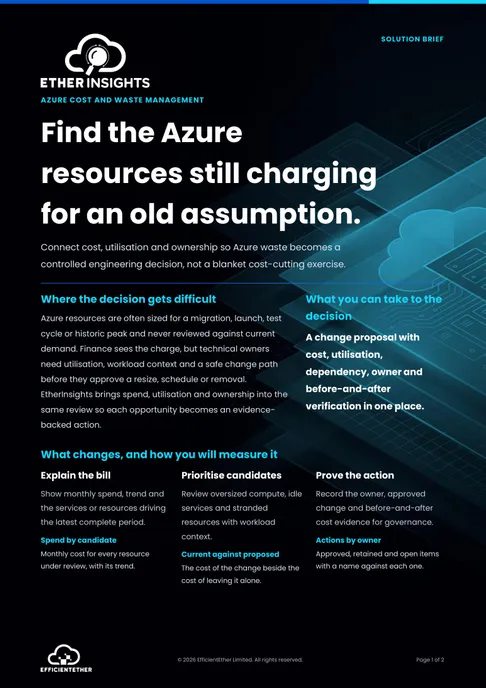
Oplossingsoverzicht
Azure Cost and Waste Solution Brief
Twee pagina's over deze beslissing: wat u meet, wie er akkoord moet geven en wat op orde moet zijn voordat u zich vastlegt. Gratis en gemaakt om door te sturen.
Vraag het oplossingsoverzicht aanVideo-walkthrough
Zie Azure kostenbewijs in context.
Gebruik de cloudkosten-walkthrough om te zien hoe Azure uitgaven, correcte maatstuiteringsbewijs en door de eigenaar gesteunde acties passen binnen de bredere besparingsreview.
- Identificeer oversized en idle compute.
- Scheid veilige veranderingen van risicovolle aannames.
- Houd VM besparingen binnen het bredere kostenbeheersingsritme.
How we deliver it
EtherInsights leidt de maatbeoordeling.
Gebruik EtherInsights wanneer Azure VM kosten meer nodig hebben dan een factuurexport: gebruiksbewijs, eigenaarcontext, kandidaten van de juiste grootte, inactieve rekensignalen en besparingsrapporten. Gebruik de bredere route van cloudkostenoptimalisatie wanneer de review ook licenties, opslag, Cloud PCs, reserveringen of abonnementsbezit behandelt.

EtherInsights is the operating view for Microsoft 365, Azure, and Windows 365: day-to-day cost management, licence control, and full Windows 365 Cloud PC lifecycle management, plus tenant, user, security, device, and Intune reporting.
Where this fits
- Azure abonnementen met virtuele machines die zijn aangepast aan oude migratie- of lanceringsveronderstellingen.
- Ontwikkeling, test of projectVMs die misschien inactief, oversized of onnodig altijd aan kunnen zijn.
- MSP of interne FinOps reviews die eigenaar-ondersteund bewijs nodig hebben voordat ze de grootte kunnen verkleinen.
- Financiën geleide kostenbeoordelingen, waarbij Azure berekeningsuitgaven een verdedigbaar technisch actieplan nodig hebben.
FAQ
Vragen van IT en finance over het dimensioneren van Azure VM's.
Heldere antwoorden over het herkennen van overgedimensioneerde virtuele machines, het met vertrouwen kiezen van een nieuwe SKU, het automatiseren van de review en het vastleggen van het bewijs dat een goedkeurder vraagt.
Wat is Azure VM right-sizing?
Right-sizing means matching each Azure virtual machine to the work it actually does, rather than the size it was first deployed at. Most estates carry VMs picked during a migration or a project peak and never revisited, so they run at a fraction of their capacity while billing at full rate. Right-sizing moves them to a smaller SKU, or shuts down the ones nothing is using.
Hoe dimensioneer ik een Azure VM stap voor stap?
Collect at least two weeks of CPU, memory, disk and network metrics so a quiet fortnight does not mislead you. Rank instances by the gap between provisioned and used capacity. Pick a candidate SKU in the same family to keep the workload profile predictable. Confirm the change with the application owner, schedule it in a maintenance window, then re-measure after a full business cycle.
Hoe vind ik overgedimensioneerde Azure VM's?
Look for sustained low CPU and memory against provisioned capacity, disks far larger than the data on them, and machines with no recent sign-in or session activity. Azure Advisor surfaces some of this. EtherInsights adds the part that usually stalls the work: it names an owner for each candidate and tracks the saving from recommendation through to approval.
Kan Azure right-sizing worden geautomatiseerd?
The analysis can be fully automated, and it should be, because it is a continuous measurement problem rather than a one off audit. The resize itself is better kept human approved. An automatic downsize on a workload with a seasonal peak or an undocumented dependency is how right-sizing programmes lose the trust of application owners.
Welke metrics gebruik ik om een Azure VM te dimensioneren?
Percentile values, not averages. A machine averaging twenty percent CPU can still hit ninety five percent at month end, and an average hides that completely. Use P95 for CPU and memory across a full billing cycle, add disk IOPS and throughput for data workloads, and check network for anything chatty.
Geldt right-sizing ook voor Azure App Service?
Yes, and it is often overlooked because App Service plans are bought once and rarely revisited. Look at the plan tier against actual request volume and memory use, consolidate underused apps onto a shared plan, and scale down non production slots. The method is the same as VMs even though the levers differ.
Hoeveel bespaart Azure VM right-sizing?
It depends entirely on how much of the estate was sized during a migration and never reviewed, so a headline percentage is not useful. Measure your own tenant instead. The honest way to size the prize is to rank candidates by monthly cost and only count the ones an owner has agreed to change.
Wat is het verschil tussen right-sizing en reserved instances?
Right-sizing reduces what you consume. Reservations reduce what you pay for the consumption you have committed to. Do them in that order, because reserving capacity you are about to eliminate locks in the wrong baseline for one to three years.
Hoe dimensioneer ik Windows 365 Cloud PC's?
Cloud PCs are sized per licence rather than per machine, so the question becomes which users are on a larger Cloud PC than their work needs, and which are provisioned but not signing in. Review usage per user against the assigned Cloud PC size, then adjust at the licence level. EtherInsights reports Cloud PC usage alongside Azure VM sizing so the two are reviewed together.
Hoe vaak moet Azure VM-dimensionering worden herzien?
Quarterly for a stable estate, monthly if you are actively migrating or scaling. The important part is that it is a standing review with an owner rather than a project. Estates drift back toward oversized within a couple of quarters once the attention moves elsewhere.
Hoe bepaalt Azure dat een VM te groot is gedimensioneerd?
Azure's eigen Advisor-aanbevelingen monitoren CPU- en uitgaand netwerkgebruik gedurende zeven dagen en markeren VM's die vier of meer dagen op 5% CPU of minder draaien, met 7MB of minder uitgaand netwerkverkeer, als laag-benut. Dat is het onderliggende signaal dat Microsoft standaard levert; de beoordeling en goedkeuring door de eigenaar rond dat signaal, niet de metric zelf, maken van een gemarkeerde VM een goedgekeurde wijziging.
Overlapt right-sizing met Azure Hybrid Benefit?
Nee, ze vullen elkaar aan. Right-sizing verandert de compute-tier van de VM zodat die overeenkomt met het werkelijke gebruik; Azure Hybrid Benefit verlaagt de kosten van de Windows Server- of SQL Server-licentie van die VM door licenties toe te passen die u al bezit onder Software Assurance. Hybrid Benefit toepassen op een te groot gedimensioneerde VM laat de dimensioneringsverspilling nog steeds bestaan, dus doe beide, niet slechts één van beide.
Bronnen Azure VM right-sizing
Beoordeeld op 25 augustus 2026.
Gerelateerde oplossingen
Related glossary terms
Start here
Vind de VMs die nog steeds kosten rekenen voor een oude aanname.
Begin met een beoordeling van Azure VM de grootte en verander oversized of idle compute in een korte, door de eigenaar gesteunde spaaractielijst.
- VM right-sizing valt binnen hetzelfde besparingsritme als Azure kostenoptimalisatie, zodat acties niet afwijken van governance.
- Kosten- en gebruiksbewijs wordt aan de eigenaren gekoppeld voordat iemand wordt gevraagd een wijziging goed te keuren.
- Beslissingen over het aanpassen van grootte, plannen, reserveren of behouden worden gepresenteerd als gecontroleerde acties in plaats van algemene kostenbezuinigingen.
- Hoe we dit meten: de cijfers op deze pagina komen uit bevindingen van eerste scans in EtherInsights, gekoppeld aan echte aanmeld-, service- en benuttingsdata, niet uit brancheonderzoeken. Uw eigen tenant bepaalt het getal, en het besparingsrapport geeft het u met het bewijs erbij.