
Solution
Des machines virtuelles Azure de la bonne taille avant le pic d’hier devienne la facture de demain.
Azure VMs sont souvent laissés dimensionnés pour la migration, le lancement ou la pire demande. EtherInsights aide les équipes à détecter des calculs surdimensionnés et inactifs, à valider les changements sûrs et à réaliser des économies sur lesquelles les détenteurs de preuves peuvent agir.
À partir de £0.79 par utilisateur actif/mois · essai gratuit de 14 jours
Carte bancaire requise pour commencer. Connectez votre tenant en quelques minutes.
10-20%
Des économies Azure récurrentes souvent obtenues grâce au bon dimensionnement et à la récupération
Dirigé par les propriétaires
Chaque candidat à redimensionnement a besoin d’un propriétaire technique et d’une trace décisionnelle
Preuves d’abord
Contexte d’utilisation, de coût et de dépendance avant changement

Mis à jour le 14 août 2026
The problem
Azure VMs rester surdimensionnés car personne ne veut casser la production pour une économie qui semble petite.
Azure virtual machines often stay sized for yesterday's peak, an old migration assumption, or a cautious launch window. Finance sees the monthly charge, but IT needs workload evidence, ownership, and a safe action path before resizing compute.
Dimensionné pour un vieux sommet
Le calcul était augmenté pour une migration, un lancement, un cycle de test ou un pic saisonnier, puis n’a jamais été examiné en fonction de l’utilisation actuelle.
Les preuves sont divisées
Le coût, le CPU, la mémoire, la disponibilité opérationnelle, le propriétaire et le contexte de la charge de travail sont situés dans des vues séparées, donc les décisions de redimensionnement prennent plus de temps qu’elles ne le devraient.
Le risque ralentit l’action
Les équipes hésitent à redimensionner, fermer ou programmer VMs lorsque la situation de la dépendance est floue ou que personne ne prend la décision finale.
What changes
Transformez les déchets informatiques en actions contrôlées.
Des candidats de taille adéquate ont donné la priorité
Les VMs de surface où le coût et l’utilisation suggèrent que le SKU actuel ne convient plus à la charge de travail.
Avis soutenu par le propriétaire
Attachez chaque candidat au bon propriétaire technique ou de service avant que le changement ne devienne un ticket ou une action de gouvernance.
Preuves d’épargne
Gardez les coûts avant/après, les notes de décision et les preuves de suivi prêts pour la finance, la direction informatique et MSP examen.
Start here
Trouvez les VMs qui facturent encore une ancienne supposition.
Voyez-le fonctionner sur votre propre tenant.
Guides et analyses sur ce sujet
La vue de taille VM
Passez de factures élevées à des décisions de calcul sûres.
EtherInsights relie coût, utilisation, propriété et preuves d’examen afin que VM changements ne soient pas traités comme des réductions de coûts aveugles. Redimensionnez, planifiez, réservez ou gardez les décisions en tenant compte du contexte.
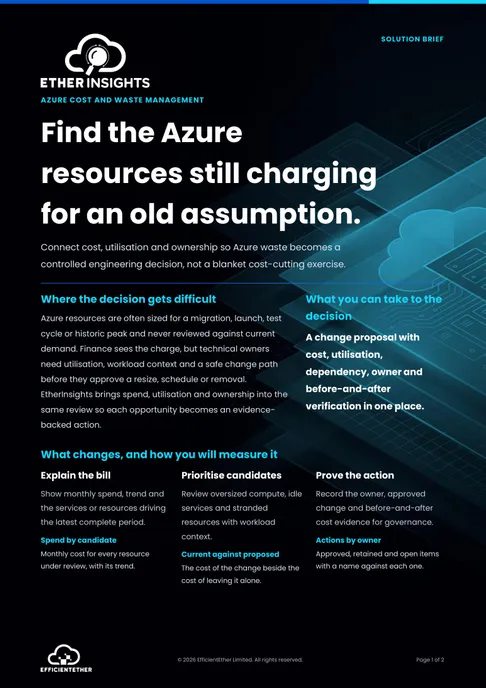
Fiche solution
Azure Cost and Waste Solution Brief
Deux pages sur cette décision : ce qu'il faut mesurer, qui doit la valider et ce qui doit être en place avant de vous engager. Gratuite, et conçue pour être transmise.
Obtenir la fiche solutionAperçu vidéo
Voir Azure données de coût dans leur contexte.
Utilisez la solution de coût cloud pour voir comment les dépenses Azure, les preuves de dimensionnement correct et les actions soutenues par les propriétaires s’inscrivent dans l’examen plus large des économies.
- Identifiez les calculs surdimensionnés et inactifs.
- Séparez les changements sûrs des hypothèses risquées.
- Gardez VM économies dans le rythme plus large de gestion des coûts.
How we deliver it
EtherInsights dirige la revue des tailles.
Utilisez EtherInsights lorsque Azure VM coût nécessite plus qu’une simple exportation de facture : preuves d’utilisation, contexte du propriétaire, candidats de taille adéquate, signaux de calcul inactifs et rapports d’économies. Utilisez la voie plus large de l’optimisation des coûts cloud lorsque la revue couvre également les licences, le stockage, la Cloud PCs, les réservations ou la propriété des abonnements.

EtherInsights is the operating view for Microsoft 365, Azure, and Windows 365: day-to-day cost management, licence control, and full Windows 365 Cloud PC lifecycle management, plus tenant, user, security, device, and Intune reporting.
Where this fits
- Azure abonnements avec des machines virtuelles dimensionnées pour d’anciennes hypothèses de migration ou de lancement.
- Le développement, les tests ou les VMs de projet peuvent être inactifs, surdimensionnés ou toujours actifs inutilement.
- MSP ou des revues internes de FinOps qui nécessitent des preuves soutenues par le propriétaire avant les actions de redimensionnement.
- Les revues de coûts axées sur la finance, où Azure dépenses de calcul, nécessitent un plan d’action technique défendable.
FAQ
Questions des équipes IT et finance sur le dimensionnement des VM Azure.
Réponses claires pour repérer les machines virtuelles surdimensionnées, choisir une nouvelle SKU en confiance, automatiser la revue et conserver les preuves qu'un approbateur demandera.
Qu'est-ce que le right-sizing des VM Azure ?
Right-sizing means matching each Azure virtual machine to the work it actually does, rather than the size it was first deployed at. Most estates carry VMs picked during a migration or a project peak and never revisited, so they run at a fraction of their capacity while billing at full rate. Right-sizing moves them to a smaller SKU, or shuts down the ones nothing is using.
Comment dimensionner une VM Azure étape par étape ?
Collect at least two weeks of CPU, memory, disk and network metrics so a quiet fortnight does not mislead you. Rank instances by the gap between provisioned and used capacity. Pick a candidate SKU in the same family to keep the workload profile predictable. Confirm the change with the application owner, schedule it in a maintenance window, then re-measure after a full business cycle.
Comment repérer les VM Azure surdimensionnées ?
Look for sustained low CPU and memory against provisioned capacity, disks far larger than the data on them, and machines with no recent sign-in or session activity. Azure Advisor surfaces some of this. EtherInsights adds the part that usually stalls the work: it names an owner for each candidate and tracks the saving from recommendation through to approval.
Le right-sizing Azure peut-il être automatisé ?
The analysis can be fully automated, and it should be, because it is a continuous measurement problem rather than a one off audit. The resize itself is better kept human approved. An automatic downsize on a workload with a seasonal peak or an undocumented dependency is how right-sizing programmes lose the trust of application owners.
Quelles métriques utiliser pour dimensionner une VM Azure ?
Percentile values, not averages. A machine averaging twenty percent CPU can still hit ninety five percent at month end, and an average hides that completely. Use P95 for CPU and memory across a full billing cycle, add disk IOPS and throughput for data workloads, and check network for anything chatty.
Le right-sizing s'applique-t-il à Azure App Service ?
Yes, and it is often overlooked because App Service plans are bought once and rarely revisited. Look at the plan tier against actual request volume and memory use, consolidate underused apps onto a shared plan, and scale down non production slots. The method is the same as VMs even though the levers differ.
Combien fait économiser le right-sizing des VM Azure ?
It depends entirely on how much of the estate was sized during a migration and never reviewed, so a headline percentage is not useful. Measure your own tenant instead. The honest way to size the prize is to rank candidates by monthly cost and only count the ones an owner has agreed to change.
Quelle différence entre right-sizing et instances réservées ?
Right-sizing reduces what you consume. Reservations reduce what you pay for the consumption you have committed to. Do them in that order, because reserving capacity you are about to eliminate locks in the wrong baseline for one to three years.
Comment dimensionner les Cloud PC Windows 365 ?
Cloud PCs are sized per licence rather than per machine, so the question becomes which users are on a larger Cloud PC than their work needs, and which are provisioned but not signing in. Review usage per user against the assigned Cloud PC size, then adjust at the licence level. EtherInsights reports Cloud PC usage alongside Azure VM sizing so the two are reviewed together.
À quelle fréquence revoir le dimensionnement des VM Azure ?
Quarterly for a stable estate, monthly if you are actively migrating or scaling. The important part is that it is a standing review with an owner rather than a project. Estates drift back toward oversized within a couple of quarters once the attention moves elsewhere.
Comment Azure décide-t-il qu'une VM est surdimensionnée ?
Les recommandations propres d'Azure Advisor surveillent l'usage CPU et réseau sortant pendant sept jours et signalent comme sous-utilisées les VM tournant à 5 % de CPU ou moins, avec 7 Mo ou moins de réseau sortant, pendant quatre jours ou plus. C'est le signal sous-jacent que Microsoft fournit par défaut ; c'est la revue et la validation du propriétaire autour de ce signal, pas la métrique elle-même, qui transforme une VM signalée en un changement approuvé.
Le right-sizing chevauche-t-il Azure Hybrid Benefit ?
Non, ils sont complémentaires. Le right-sizing change le niveau de calcul de la VM pour correspondre à l'usage réel ; Azure Hybrid Benefit réduit le coût de la licence Windows Server ou SQL Server de cette VM en appliquant des licences que vous possédez déjà sous Software Assurance. Appliquer Hybrid Benefit à une VM surdimensionnée laisse quand même le gaspillage de dimensionnement en place, donc faites les deux, pas l'un ou l'autre.
Sources sur le right-sizing des VM Azure
Vérifié le 25 août 2026.
Solutions associées
Related glossary terms
Start here
Trouvez les VMs qui facturent encore une ancienne supposition.
Commencez par une revue de taille Azure VM et transformez le calcul surdimensionné ou inactif en une courte liste d’actions d’épargne soutenue par le propriétaire.
- VM dimensionnement correct s’inscrit dans le même rythme d’épargne que Azure'optimisation des coûts, afin que les actions ne s’éloignent pas de la gouvernance.
- Les preuves de coût et d’utilisation sont reliées aux propriétaires avant que quiconque ne soit sollicité pour approuver un changement.
- Les décisions de redimensionnement, de calendrier, de réserve ou de conservation sont présentées comme des actions contrôlées plutôt que comme des coupes budgétaires globales.
- Comment nous mesurons : les chiffres de cette page proviennent des constats du premier balayage dans EtherInsights, rapprochés des données réelles de connexion, de service et d'utilisation, et non d'enquêtes sectorielles. C'est votre propre locataire qui fixe le chiffre, et le rapport d'économies vous le donne avec les preuves.