
The Windows Application Migration and Packaging Handbook
Plan, package, test, and move Windows applications into production with clear ownership.
Windows and Office CVEs rose 159.1% in the latest complete year, to 2,438, while browsers and developer tools moved to faster release cycles. A 36-month descriptive study of what that means for patching and packaging teams.
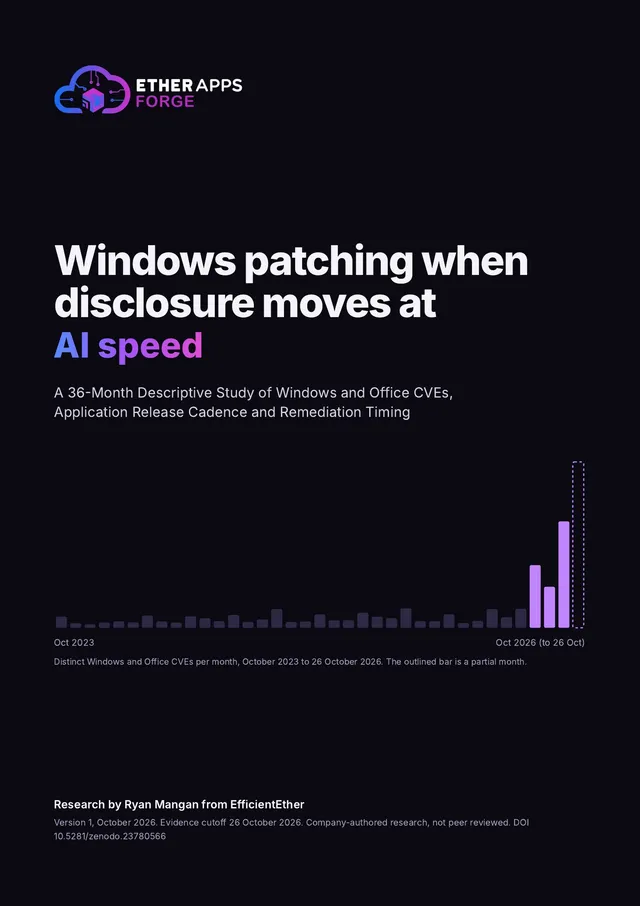
Research paper. 36 pages. Reviewed 29 October 2026.

Research by Ryan Mangan from EfficientEther.
Decide how your team keeps up with more disclosures, faster application releases and proof that each fix is running.
Cumulative Windows updates still arrive on the second Tuesday, but the work around them no longer follows a monthly calendar. In the latest complete year, October 2025 to September 2026, the study counts 2,438 distinct Windows and Office CVEs, up 159.1% on the 941 of the year before and the 679 the year before that, with the surge concentrated in mid to late 2026. Over the same period Chrome and Edge moved to two-week major release cycles, Firefox announced the same, and Visual Studio Code moved to weekly releases. Patch volume is no longer a monthly event, and packaging and endpoint teams feel it first.
The paper measures what changed and is careful about what it cannot show. Mean CVSS v3 severity was broadly unchanged (7.43, 7.37, 7.28), yet CVEs scored 9.0 or above rose from 11 to 60. Eighteen Windows CVEs carry documented AI-assisted discovery credit, a source-verified set of examples and not an estimate of the AI share. Across 4,058 CVEs in 36 months there were no usable structured repair-time date pairs, so a whole-cohort average repair time cannot be estimated; dated cases are reported under their own clocks instead.
For application packaging teams it turns the numbers into an operating model. A panel of six release streams (Chrome, Edge, Firefox, Visual Studio Code, Notepad++ and 7-Zip) ranges from 4 release days in a year for 7-Zip to 69 for Edge, with Chrome at 64 and Visual Studio Code at 61. The paper proposes five work lanes for those streams, a nine-gate pipeline from trusted source to verified protection, and a clear split: automation carries build, deployment and test execution, while people own the test criteria, what counts as a pass and which exceptions are acceptable.
Patch-management, endpoint and application packaging teams, security and vulnerability managers, end-user computing leads and MSPs. Chapter 5 includes a planning equation and a worked table with deliberately invented inputs, so you can replace them with your own release and effort figures.
Cite as Mangan, R. (2026). Windows Patching, AI-Assisted Discovery and Application Assurance. Zenodo. https://doi.org/10.5281/zenodo.23780566
Get the paperEtherApps Forge captures, builds, signs and smoke-tests a package on a Windows machine in your own environment, so packages stay with you.
7 days, full workflow, no credit card. £895 per admin user per year after, excluding VAT.

Plan, package, test, and move Windows applications into production with clear ownership.
Measured MSIX results, Microsoft platform changes, 2026 packaging prices and a transparent cost model for deciding how your organisation packages applications.
Find avoidable Microsoft 365 and Azure spend, agree changes with the right owners, and confirm the result before reporting savings.