


Solution brief · EfficientEther and 10ZiG partnership
10ZiG and EtherInsights Solutions Brief
The Windows 365 case stalls when the endpoint estate and the sizing evidence sit in different conversations. See how both ends close on one comparable term.
Send me the solution brief
Enter your details and we will email your copy.
What this solution brief helps you decide
Put the endpoint estate and the Cloud PC sizing evidence into the same business case.
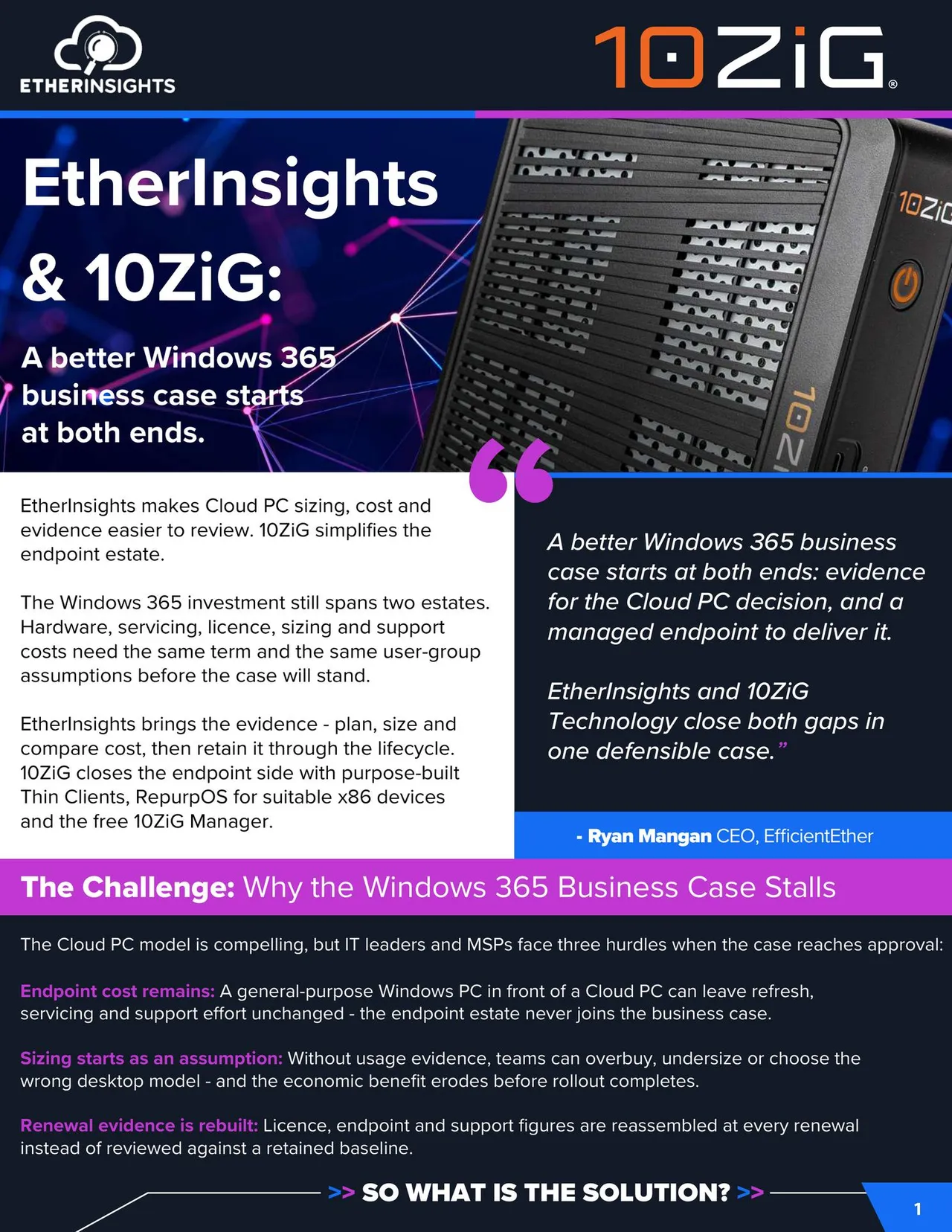
The Windows 365 case usually stalls for three reasons, and none of them is the licence price. A general purpose Windows PC left in front of a Cloud PC keeps refresh, servicing and support effort unchanged, so the endpoint estate never joins the case. Sizing starts as an assumption, so teams overbuy or undersize. And the licence, endpoint and support figures are rebuilt from scratch at every renewal instead of reviewed against a retained baseline.
This brief sets out how the two ends close. EtherInsights is the evidence layer: plan, size and compare cost by user group, keep an Azure Virtual Desktop or older VDI baseline visible, and retain configuration evidence through the lifecycle. 10ZiG covers the endpoint with purpose built thin clients and zero clients, or RepurpOS for suitable existing x86 PCs and laptops, managed through 10ZiG Manager.
It then gives the approval group what it actually asks for: current cost, proposed route, transition work and the evidence to be reviewed after rollout, all on one comparable term.
- A four step decision process: profile the work, choose the endpoint, choose the desktop, then validate and operate.
- Why the endpoint estate has to be priced on the same term as the Cloud PC licence.
- Which evidence finance, IT operations, security and the service owner each need from one record.
- Where Windows 365 Enterprise, Windows 365 Flex and Azure Virtual Desktop each fit by user group.
- What a decision record you can forward contains: user group, route, cost, endpoint, test result, owner, conditions and decision date.
What you get
- Three pages, covering the challenge, the complementary operating model and what the approval group needs.
- The four step decision process, with the questions to settle at each step.
- A stakeholder evidence table for finance, IT operations, security and the service owner or MSP.
- Decision criteria for the commercial case, operational fit, rollout and renewal, plus what to evaluate separately.
Who it is for
MSPs and IT teams with about 50 to 600 users per tenant, persistent Cloud PCs and ageing endpoints. Written so the budget owner can read the cost case and the operations lead can read the endpoint and sizing detail without either asking for a separate document.
Get the solution brief