


Solution brief · Secure it and prove it
Microsoft 365 Tenant Backup and Drift Solution Brief
A policy or assignment change can affect security, compliance or device behaviour long after the change request closed. Keep configuration history, see drift with the actor named, and make the restore decision provable.
Send me the solution brief
Enter your details and we will email your copy.
What this solution brief helps you decide
Know what changed, and who changed it, before you plan a configuration restore.
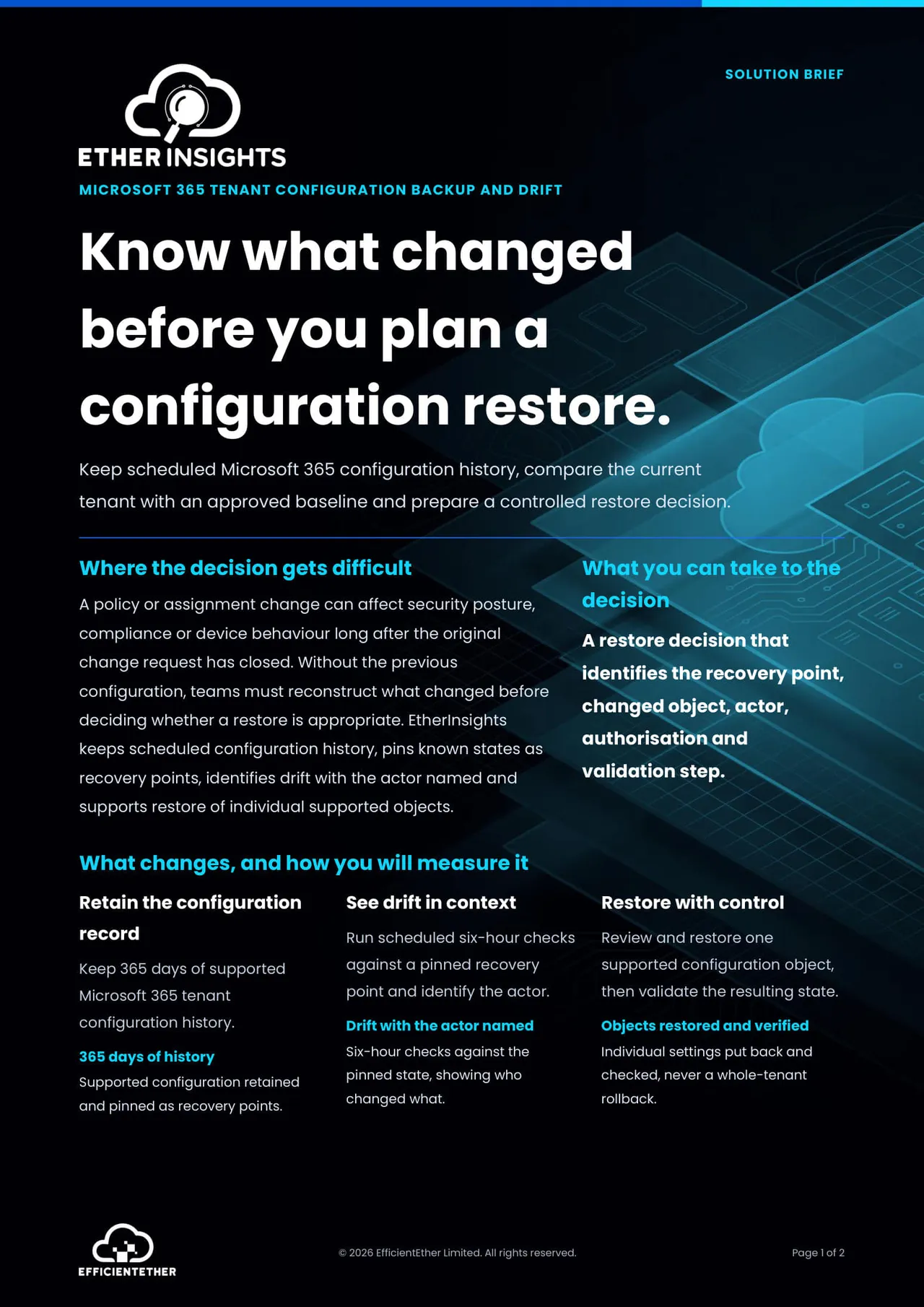
A policy or assignment change can affect security posture, compliance or device behaviour long after the original change request closed. Without the previous configuration in front of you, the first hours of the investigation go on reconstructing what changed at all, before anyone can decide whether a restore is the right answer.
This brief describes the control that removes that step. Up to 365 days of supported Microsoft 365 tenant configuration history is retained and written to protected, customer controlled storage. Known good states are pinned as recovery points. Scheduled checks every six hours compare the tenant with the pinned state and identify the actor behind each difference.
Restore is deliberately selective. One supported configuration object is reviewed, put back and then validated, rather than rolling the tenant back as a single block. The brief is equally clear that this is configuration protection, not mailbox, SharePoint, OneDrive or Teams content backup, and that six hours is a check cadence rather than a stated recovery point objective.
- Which Microsoft 365 configuration objects and services are in supported scope.
- How 365 days of history and six hourly drift checks fit an operating requirement.
- Why naming the actor changes the restore conversation.
- Who may review, approve and execute a restore, and how that authority is recorded.
- How the restored configuration is validated against service and security expectations afterwards.
What you get
- Two pages: where the decision gets difficult, what changes and how you measure it, and the four questions to settle first.
- Three measures to track: 365 days of history, drift with the actor named, and objects restored and verified.
- A scope statement separating tenant configuration protection from content backup.
- One live decision to test the approach on, using a single controlled policy change.
Who it is for
IT leaders, Microsoft 365 owners, security leads and MSPs responsible for tenant configuration recovery. Useful when a change board asks what the rollback plan is and the honest answer today is a manual rebuild.
Get the solution brief