
Windows 365 became generally available on 2 August 2021. Five years on, Microsoft marked the anniversary by pointing to a platform used by "tens of thousands of organizations across industries and around the world," a fourth consecutive year as a Leader in Gartner's Magic Quadrant for Desktop as a Service, and a Leader placement in IDC's 2026 DaaS MarketScape. Microsoft's own retrospective cited reduced costs, lower network latency, fewer support tickets, and faster employee onboarding across the organisations it featured. The milestone matters less as a birthday and more as a signal: Cloud PCs have moved from a pilot project to infrastructure most IT leaders now plan around by default.
Five years, from pilot to platform
Windows 365 launched as a single idea: a Cloud PC, streamed rather than provisioned, billed per user rather than per session. What shipped since has broadened that considerably. Windows 365 Flex brought part-time and shift-based licensing for frontline roles. Windows 365 Reserve added temporary Cloud PCs for business continuity when a primary device fails. Windows 365 Link introduced a purpose-built thin client for organisations standardising on Cloud PC as the endpoint. Most recently, Windows 365 for Agents gave AI agents a governed execution environment separate from a human user's desktop.
That range of shipped capability is exactly what analyst recognition rewards. Gartner's four-year run as a Magic Quadrant Leader and the "highest in Ability to Execute" placement, alongside IDC naming Microsoft the only vendor to productise the agentic workspace as a distinct purchasable offering, are both read by procurement and security teams as a lower-risk signal than a newer entrant. For an IT leader who has to defend a platform choice to finance or the board, five years of sustained investment and independent validation is easier evidence to present than a roadmap promise, and it is the kind of evidence that belongs in a cost and governance case rather than a slide of feature names.
What's new as the platform grows up
Microsoft's anniversary post paired the milestone with a genuine feature wave, not just a retrospective. For engineering and platform teams, ready-to-code Cloud PCs (preview) ship with development tooling preconfigured, Windows 365 GPU Select is now generally available, and 32vCPU Cloud PCs extend the ceiling for compute-intensive workloads, including running language models directly on the Cloud PC. For security and compliance-led organisations, context-based redirections using Entra authentication and output protection capabilities (general availability September 2026) add controls that regulated industries, in particular, have been asking for since Cloud PCs started handling sensitive data. For admins running the estate day to day, a new monitoring and reporting platform reaches general availability the same month, alongside a limited-preview AI admin agent aimed at troubleshooting.
Windows 365 for Agents is the structurally new piece. Microsoft frames it as a secure execution environment for AI agents, distinct from a human Cloud PC, with Autopilot device profile integration and Microsoft Execution Containers support arriving in the coming months. Partners named in Microsoft's own post, including Login VSI and WorkspaceDNA, are already building agents that run on it. Whatever an organisation's stance on agentic AI today, this is Microsoft treating agent workloads as a first-class Cloud PC category rather than an afterthought, and that changes what "the Windows 365 estate" means for the teams managing it.
Two of the headline items, output protection and the new monitoring and reporting platform, both reach general availability in September 2026, weeks after this anniversary post. That is a narrow window to decide how those controls slot into an existing Windows 365 baseline before they are switched on for everyone by default. Waiting until after GA to work out who owns that decision is how governance gaps open up on a platform that otherwise has a strong five-year track record.
A bigger platform means a bigger operating surface
None of this is free to operate. Each new SKU, from GPU-enabled Cloud PCs to 32vCPU tiers to agent execution environments, is a new cost variable to track and a new configuration to keep aligned with policy. The right response to that growth looks different depending on which seat you sit in.
For an enterprise EUC or Cloud PC lead planning the next migration wave, more SKUs mean more cohort decisions to get right before rollout, not fewer: which users get standard Business Cloud PCs, which engineering or data-science teams justify a GPU-enabled or 32vCPU tier, and how that mix compares to what an existing Azure Virtual Desktop or legacy VDI estate already costs. For an MSP running Cloud PCs across dozens of client tenants, it means keeping one consistent baseline and reporting standard across every one of them, even as Microsoft ships new capability every few months, so scale does not turn into a support cost per tenant. For a security or compliance stakeholder, most visibly in regulated sectors such as financial services, healthcare, and the public sector, an execution environment built for autonomous agents is a governance question from day one: who approved it, what data can it reach, and how is that evidenced, not something retrofitted once agents are already running workloads.
This is the pattern every maturing Microsoft platform follows: the harder problem stops being "should we adopt this" and becomes "how do we run this well at scale, without losing visibility as it grows." Windows 365 turning five, with a fourth straight Gartner Leader ranking behind it, is Microsoft's answer to the first question. The second question is where most Cloud PC programmes actually stall.
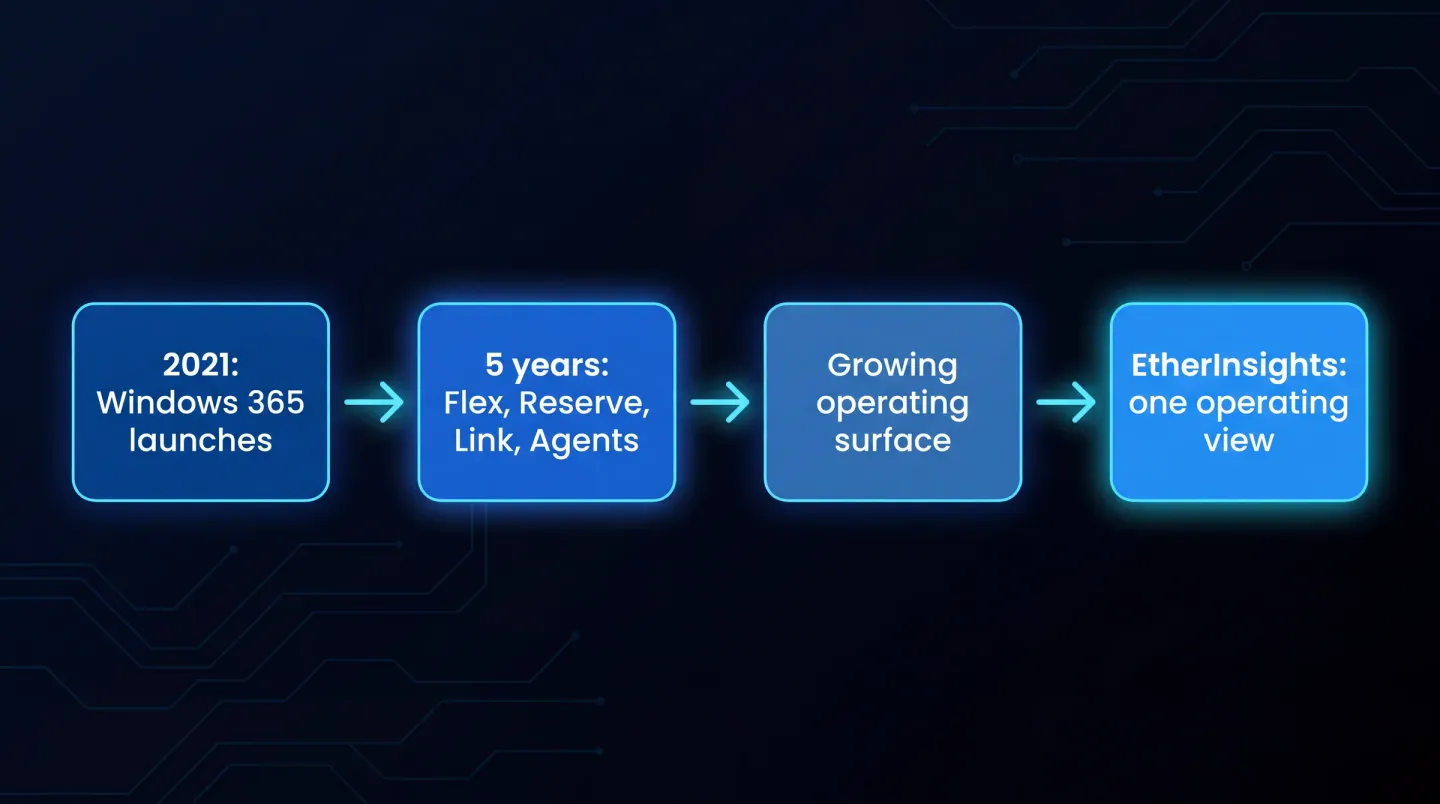
Five years of Windows 365 capability adds up to a wider operating surface than a spreadsheet can track alone.
Where EtherInsights fits
EtherInsights exists for exactly that second question. It gives Windows 365 and Cloud PC planning, deployment, and day-two management a single operating view instead of a spreadsheet rebuilt every quarter: plan Windows 365 Business or Enterprise cohorts, compare against an existing Azure Virtual Desktop or legacy VDI baseline, track configuration drift after go-live with per-object restore on change, and keep day-two support evidence visible for the teams who inherit the estate once the migration project ends.
That operating view scales the way the platform itself has. A Windows 365 migration from AVD or legacy VDI gets cohort-by-cohort cost and readiness evidence before the first wave ships, not after. An MSP managing Cloud PCs across multiple tenants gets the same reporting standard on every one of them, which is the difference between a service that scales and one that gets slower with every new client. And as Microsoft keeps adding SKUs, tiers, and now agent workloads to what a "Cloud PC" can be, having one place that tracks cost and drift across all of them is what keeps that growth from turning into blind spend rather than a five-year platform investment paying off as intended.
Microsoft recently listed EfficientEther on its own Windows 365 partners page, describing EtherInsights, EtherAssist, and EtherApps Forge directly. If you are already comparing the cost case for a Windows 365 rollout, the AVD to Windows 365 migration cost breakdown is a practical next read.
See how EtherInsights fits your Windows 365 and Cloud PC estate, or try it free to bring your first cohort into one operating view.