
Windows Installer Types and Their Market Prevalence: Our New Research
Our WinGet census of 15,880 packages: 56.9% use a setup-engine EXE, 16.6% an MSI and 1.6% MSIX. Only 7 of 50 popular products publish an MSIX.

Which installer types does Windows software actually use, and how common is MSIX? We counted every package in the Windows Package Manager (WinGet) community repository, 15,880 in all. Setup-engine EXEs are the largest route at 56.9%, followed by portable applications at 24.9% and MSI at 16.6%. MSIX or APPX is 1.6%. Of 50 popular products chosen by a rule fixed before we checked, 7 (14.0%) publish an MSIX. These figures describe what is available in a public catalogue, not what is installed on devices.
This post summarises our new paper, Windows installer types and their market prevalence, and keeps what the data shows apart from what it cannot show.
What we counted
We fetched and parsed all 15,880 packages at one commit of the microsoft/winget-pkgs repository on 2 November 2026, with no failed fetches. Each package is counted once, by the type of its primary installer. For a zip, the primary type is the type of the installer inside it. Because every package was measured, these are exact counts for that snapshot, not sample estimates.
One limit applies throughout: the census reads the installer types that package authors declare. It did not open the installers to test the declarations.
How Windows software ships
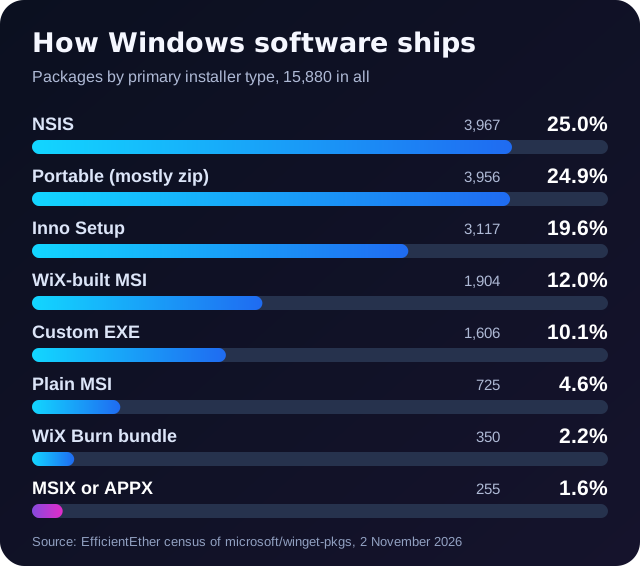
Primary installer type of 15,880 WinGet packages, one count per package. Source: EfficientEther census, 2 November 2026.
Grouped into families, the result is simple:
- Setup-engine EXEs: 9,040 packages (56.9%). These are executable setup programs built with an engine such as NSIS or Inno Setup, plus custom EXEs and WiX Burn bundles. NSIS and Inno Setup lead.
- Portable applications: 3,956 (24.9%). Most of these arrive as a zip. Of the 3,409 packages whose primary entry is a zip, 83.7% hold a portable application, so a zip is usually a container for software that needs no setup.
- MSI: 2,629 (16.6%). These are installed by the Windows Installer service: 1,904 built with WiX and 725 plain MSI.
- MSIX or APPX: 255 (1.6%). These are Windows application packages with package identity and differential updates, and an MSIX can be deployed outside the Microsoft Store. That is 219 MSIX and 36 APPX. A wider reading also counts packages that ship an MSIX another way: 10 hold one inside a zip, and 17 list one under Apps and Features entries while installing through another type. Counting them lifts the share to 1.8%.
Packages rarely offer a choice: only 720 (4.5%) offer more than one installer type.
Do popular products publish an MSIX?
A catalogue count gives small utilities the same weight as large suites, so we added a second question. Of 50 popular Windows products, how many publish an MSIX? We fixed the rule and froze the list before checking any product: take the ordering of winstall.app, skip runtimes, command-line tools, libraries, drivers and Windows components, and stop at 50 vendor products.
- 7 of 50 (14.0%) publish an MSIX. The 95% interval is 7.0% to 26.2%.
- 36 (72%) had no MSIX route after checking vendor documentation and the WinGet manifest, including Google Chrome, Adobe Acrobat Reader, Zoom Workplace, Visual Studio Code, Docker Desktop, Discord and Microsoft Edge.
- 6 (12%) are packaged as MSIX in the Microsoft Store only, and one could not be determined.
The seven are Claude, Mozilla Firefox, Windows Terminal, Microsoft Teams, Bitwarden, Notion and Windows App, so Microsoft accounts for three of them. Firefox and Bitwarden publish an MSIX that WinGet does not list, so a WinGet-only count understates the vendor route. A Microsoft Store listing is never counted as a vendor publishing an MSIX, because the Store also accepts MSI and EXE submissions.
Is MSIX growing?
Yes, slowly. We re-read the same repository at five past dates, using one fixed rule: a package counts if its installer manifest declares msix or appx. The same rule gives 258 of 15,880 packages (1.62%) in November 2026, slightly different from the primary-type count above.
| Snapshot | Packages read | MSIX or APPX | Share |
|---|---|---|---|
| 30 September 2023 | 5,236 | 52 | 0.99% |
| 30 September 2024 | 6,700 | 69 | 1.03% |
| 31 March 2025 | 8,111 | 102 | 1.26% |
| 30 September 2025 | 10,071 | 152 | 1.51% |
| 31 March 2026 | 12,149 | 192 | 1.58% |
| 2 November 2026 | 15,880 | 258 | 1.62% |
The MSIX count rose 5.0 times while the catalogue rose 3.0 times. Most of the rise came in the year to September 2025. In the 13 months since, the share has added 0.11 percentage points. Of the 6,024 packages added since September 2025, 1.5% declare an MSIX, no higher than the 1.7% among packages already present. The recent rise is therefore mostly the catalogue growing, with a few existing packages adding an MSIX, and not a surge of MSIX among new entries. The data is descriptive and does not say why publishers choose a format.
What other public catalogues show
Other catalogues measure different things, so we did not average them. Add Remove Programs classifies one selected download for each of 13,621 examined applications: 68.2% are EXE, 17.9% MSI and 0.3% MSIX. The five official Scoop buckets hold 5,257 manifests, 65.3% of them archives and 0.27% MSIX or APPX. Chocolatey lists 12,140 packages but publishes no installer-type split. The WinGet figure is the only one here that counts every package once by its primary installer type.
What the data does not tell you
- It is availability, not usage. We found no source that publishes installations by installer technology, and no Microsoft figure for MSIX adoption.
- Popularity is not enterprise weight. The ordering behind the 50 products reflects developers and power users more than enterprise estates.
- Enterprise packaging looks different. A 2025 survey by Bob Kelly of Juriba reports MSI at 88% coverage among application repackaging formats, with compatibility concerns (66%) and lack of expertise (48%) as barriers to MSIX. Its sampling detail is thin, so read it as directional evidence of MSI's continued importance.
- Declared is not verified. Types come from manifests, not from opening installers.
- We have an interest. The paper is company-authored and not peer reviewed, and EfficientEther makes EtherApps Forge.
What it means for packaging teams
Most software in public catalogues arrives as an EXE setup, a portable application or an MSI, and few popular products publish an MSIX. A move to Windows 365, Azure Virtual Desktop or Microsoft Intune therefore needs a route from those formats to the packages the target platform expects, not only a way to deploy them.
Microsoft's guidance is scoped in the same way. Its packaging overview says new apps deployed through Intune or Configuration Manager should use MSIX, and that existing apps with their own installer can use packaging with external location instead. Intune still distributes Win32 installers once the content is prepared as an .intunewin file, so adopting cloud management does not by itself mean a move to MSIX.
A practical order of work follows from the figures:
The public figures are a guide, not a forecast for your estate. Your own applications, including private line-of-business software that no catalogue lists, are the honest test. Our earlier study, MSIX at Scale, found that an automated workflow built an MSIX for 90.68% of 3,261 application cases, and 80.04% passed a recorded smoke test. That describes the sample, not a compatibility rate for your applications. Our State of Application Packaging in 2026 report adds the published packaging prices and a cost model with every assumption stated.
Where EtherApps Forge fits
The paper does not evaluate EtherApps Forge or any commercial product, and EfficientEther declares its interest in the paper. For teams working through a mixed estate, EtherApps Forge captures applications where they already run, even when the installer is lost, and builds signed MSIX, MSI, Intune and App Attach packages from one capture.
Its agentic application packaging workflow recommends a route from the real application footprint. MSIX packaging and deployment covers how those packages reach Intune and Azure Virtual Desktop, and legacy app packaging and installer recovery covers the lost-installer path, which our guide on repackaging an application when the installer is lost walks through. More of our evidence is in the EfficientEther research hub.
Get the Windows installer research to read the census, the vendor check, the trend and the limits in full.